The Solutions Artist: From Dubai to Sweden, Building the Future of Tech

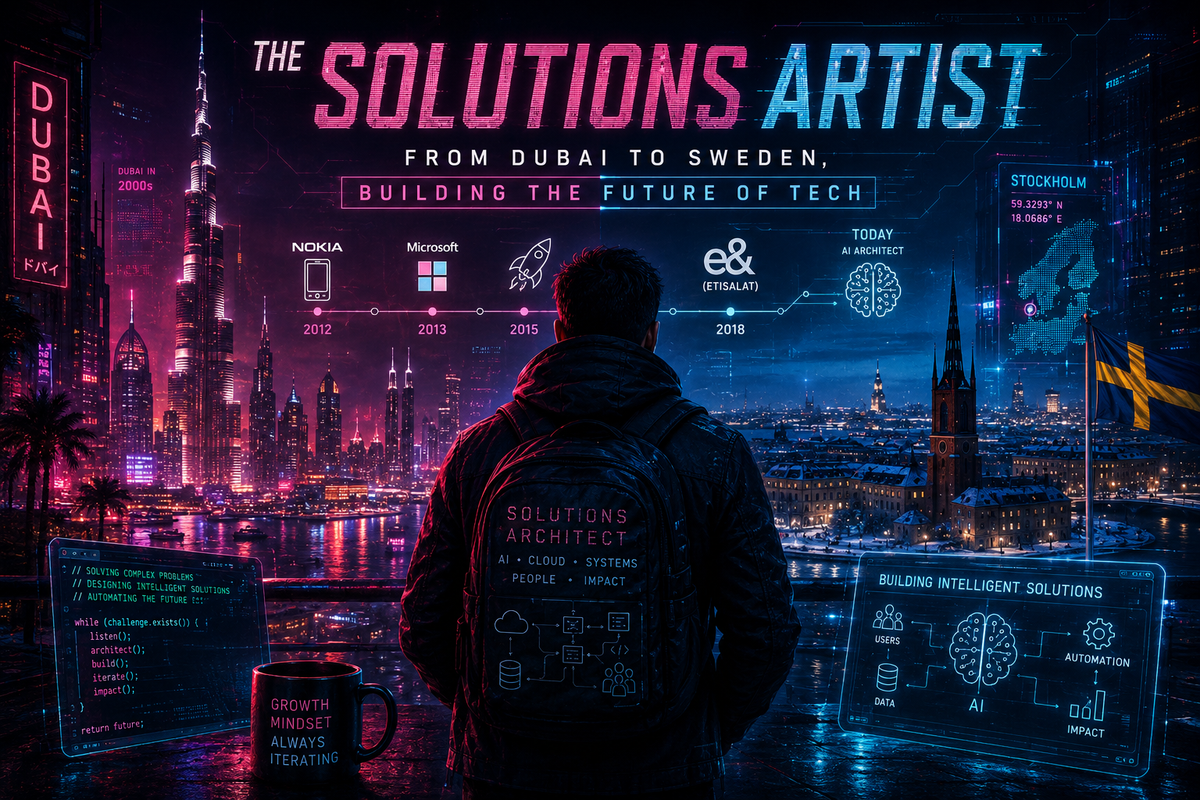
Two months old. That's how old I was when my parents put me on a plane from Karachi to Dubai. I never chose the city that would shape most of my life. But 32 years later, when I packed up my family and moved to Sweden, I realized Dubai had shaped almost everything about who I am, professionally and personally. This is the story of how a Dubai kid ended up as an AI Architect in European energy industry. Not the polished LinkedIn version. The real one.
Growing up in Dubai
Dubai in the early 2000s was a city figuring itself out. Buildings were going up everywhere, talent was pouring in from every corner of the world, and nobody was quite sure what a "knowledge economy" was supposed to look like yet. I watched all of that from the inside, growing up in a place where change was the only constant.
I studied Computer Science for my bachelor's, then obtained my master's in IT. Right after my bachelor's, I got my first job at Nokia, then soon at Microsoft, and during my master's, I joined a startup that gave me my first real taste of building things from scratch. After that, I reunited with the corporate world by joining Etisalat, now known as e&, one of the largest telcos in the region.
The pace was relentless. The teams were multicultural. The projects cut across departments. You either adapted, or you got left behind. I didn't just grow up in Dubai, I developed a growth mindset in the city.
Nokia and Microsoft: Learning to listen
I started at Nokia in November 2012 as a Developer Support Analyst. Back then, Nokia was a different company. The classic mobile phone era was winding down, and the whole organization was pivoting into touchscreen, app-driven devices.
My job was to support developers, consult the company's top partners in the region, build high quality mobile apps for them, troubleshoot issues, and watch how products and customers were at the heart of a massive organization.
It was my first gig, but it taught me something I still carry with me: the person using your product matters just as much as the product itself; the product being a physical device, an application running in it, or a system around it. I didn't know it yet, but that instinct would become one of the most important tools in my kit.
Not long after I settled in, Microsoft acquired Nokia's phone business. Overnight, my Nokia colleagues and I became Microsoft employees. Same role, but a completely different environment.
Microsoft's "growth mindset" culture wasn't just a slogan on the wall: you could feel it in how people approached problems, in how they talked about failure, in how they iterated. I spent my time there learning how one of the biggest software companies on the planet thinks about developer experience, technology, tooling, and platform strategy.
Looking back, those two experiences gave me something I didn't realize I was building at the time: a deep, almost automatic instinct for listening to the people who have to live with your technical decisions.
The startup years: Rise of the Engineer
Back then, my head was mostly in the code. What I wanted, more than anything, was to be a "real" Software Engineer. So I joined a media streaming startup in August 2015 as the Universal Windows Platform lead engineer, and for the first time, I wasn't just consulting the partners or building apps for them. I was building customer-facing solutions that could impact the company's credibility and business - both positively and negatively. A small issue could result in a negative feedback, and a single negative feedback for a startup results in the loss of its reputation and revenue.
The startup moved fast, made mistakes, pivoted, and kept going. I did the same. I was promoted to Senior Software Engineer and expanded beyond the Microsoft ecosystem, taking on iOS and tvOS development as well. Handling both Windows and Apple platforms gave me a broad perspective on how different ecosystems solve the same problems, and took me out of my .NET comfort zone.
What I loved most was the domain. We were streaming content to edge devices across multiple platforms, and I got to understand how services like Netflix and Amazon Prime actually work under the hood. The technical depth of real-time video delivery, adaptive streaming, and cross-platform rendering taught me more than any corporate project had.
That role sharpened my engineering and interpersonal skills in ways the corporate environments hadn't. But more importantly, it started pulling me toward a bigger picture. I started caring less about individual functions and more about how all the pieces fit together. Solution Architecture was calling, though I didn't have the word for it yet.
e& (Etisalat): Where the Architect woke up
In September 2018, I joined e&, back then called Etisalat, as a Senior Engineer in Ajman. I stayed for almost four years, and honestly, this is where my career started to take a different shape. e& is one of the biggest telecom groups in the Middle East. The scale was unlike anything I'd experienced. As a part of the Intelligent Operations initiative, we were designing systems that handled users from all corners of the business, both humans and machines, in real time, with integrations spanning multiple business units. Good code was the minimum requirement. You also had to think about reliability, security, scalability, and how everything connected.
Nobody gave me the title of architect. The work demanded that kind of thinking on its own.
Kraken
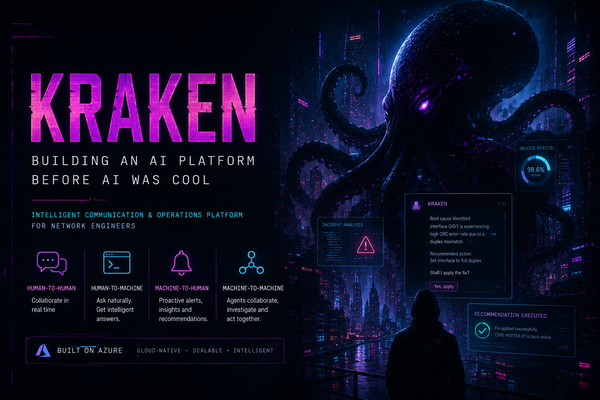
Around this time, I built something I'm genuinely proud of: Kraken, an Intelligent Communication and Operations Platform. Think of it as a precursor to ChatGPT, built specifically for network engineers, years before the AI hype took off. It was a system of bots that helped operational teams with everything from answering questions to running end-to-end automation. I'll share the full story in a separate post, but the moment that stuck with me was watching a network engineer use Kraken to diagnose a device issue in less than a minute, something that would have normally taken a twenty-minute call to the support engineers. That moment showed me the gap between building something that works and building something that genuinely changes how an organization operates.
Family and the move to Sweden
I got married in March 2018, a few months before I joined e&. My wife and I were building our life together while I was building systems at scale. Both required patience, planning, and a willingness to roll with the unexpected.
In May 2022, we made the biggest decision of our lives. We left Dubai, where I'd lived for 32 years, and moved to Sweden with our 3-year-old son. I was walking away from my entire network, my comfort zone, and a career path that was going just fine.
People always ask why. Honestly, I wanted a different life for my family. Dubai gave me everything, personally and professionally. But Sweden offered something I didn't know I needed. A pace that let me breathe, think, and build things with intention instead of urgency.
That same year, my younger son was born. Between a new country, a demanding role, and two kids under five, life was full. But it was the right kind of full. Watching my kids grow up in a country that truly values balance, education, and sustainability changed how I think about what technology is supposed to serve. Technology should make life better, not just more efficient.
Klarna: Engineering at scale
That first year in Sweden was humbling. I joined Klarna as a Cloud Architect (AWS) Consultant in Stockholm, hired through a firm called Human IT, which was later acquired by Atea. Klarna is one of Europe's biggest fintech names, and the engineering culture hits hard.
I was placed in the Cloud Protection team, which was responsible for the security side of things, especially around API gateways and internal toolsets.
We made sure the API gateways were secure and could handle massive scale: Black Friday surges, flash sales, and DDoS attacks. We hardened VM and container images for compliance. We ensured internal systems were accessed securely through tools like bastion hosts.
I got to experience a real DDoS attack during my time there. The traffic pattern during an attack looks nothing like a Black Friday surge, and understanding that difference taught me more about system resilience than any course could.
But the most important thing I learned at Klarna wasn't about security. It was how real DevOps works in a secure environment. Proper CI/CD pipelines, autonomous deployment operations, pipeline security, PR reviews, branching strategies, environment management. I'd done DevOps before, but this was the first time I saw it done at scale, with the discipline and rigor that a fintech company demands.
I also saw how operations teams could work together in an agile SCRUM setup, and how they constantly strived to improve their ways of working, something that changed how I thought about team structure and delivery.
What struck me most was the culture. In Dubai, the tech environment is competitive. You prove yourself by knowing the answer, by being the one who can solve it. Asking for help feels like admitting weakness. At Klarna, it was the opposite. Teammates actively helped each other grow. You could ask questions openly, without fear of judgment, and people would stop what they were doing to walk you through something. Instead of feeling left behind as the newcomer, I felt supported. That shift in culture changed how I thought about teams, leadership, and what it actually means to build a strong engineering organization.
I was the newcomer again, in a brand new country, a new market, a new way of working, surrounded by new people. After 32 years of building expertise, being a beginner again was uncomfortable.
It was also exactly what I needed.
2023 gave me more than just my younger son. It also brought an assignment at E.ON as a Platform Specialist Consultant in September, working mainly on Azure migrations and Azure-powered solutions. That assignment would change everything.
E.ON: Where it all came together
In May 2025, I joined E.ON full-time, one of Europe's largest energy companies, based in Malmö, Sweden. I started as a Cloud Solution Architect. By October, I was given the role of Product Architect. By May 2026, I was appointed AI Architect.
Three roles in a year. The transitions weren't always smooth.
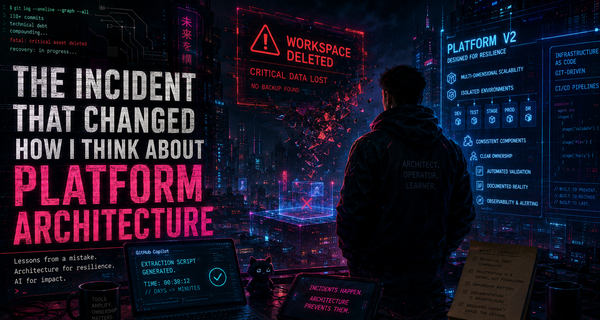
I'll share one moment that taught me more than any success. Early on, I was managing a poorly architected platform with five inconsistent environments and no clear ownership. Out of frustration, I accidentally deleted a data team's critical workspace. They hadn't backed up their code or artifacts. The workspace was eventually recovered, but the incident forced me to confront something: frustration with a bad system doesn't excuse bypassing it recklessly. I took that frustration and channeled it into designing V2 of the platform with a cleaner architecture, and a multi-dimensional vision. I'll tell the full story in a separate post, but the lesson stayed with me: sometimes the best design work comes from living with the consequences of a bad one.
Each role at E.ON built on the last, and a clear thread emerged: making complex things clear.
At E.ON, I sit at the crossroads of business strategy and technology innovation. The energy sector is going through a transformation that makes cloud migration look like a quick patch. Decarbonization, grid modernization, distributed energy resources, AI-powered optimization. It's a lot. And architecture sits right at the heart of all of it.
Over 14 years, I picked up skills that turn out to be exactly what this industry needs. Seeing systems as a whole, not just individual parts. Translating between the technical and business sides. Making decisions when you don't have all the answers. The tools and platforms change. The ability to think architecturally doesn't.
What I actually do
I don't have one title that captures it all. Officially, I'm an AI Architect; functionally, a Product Architect. My experiences allow me to also consider myself as a Cloud Architect and a Platform Engineer. I aspire to think like an Enterprise Architect. At my core, I am still a tinkerer, a Full-stack Developer at times, an automation Engineer at others. What ties it all together is simple: I work where business vision, technology innovation, and architecture meet. And a love of all things tech.
I also love experimenting. My personal projects are just as much a part of my growth as my day job. Some of them turn into blog posts. Some of them turn into nothing. Both outcomes teach me something.
If I had to put it in a sentence: I turn complexity into clarity and ideas into solutions that matter. That's where the name The Solutions Artist comes from.
What I've learned
A few things have stayed with me:
Being a generalist is a strength. I used to worry it meant I wasn't deep enough in anything. Moving between AI, cloud, product, and platform architecture showed me the opposite. I see the whole system, not just one piece of it. That perspective is rare, and it's valuable.
Context beats optimization. The best architecture is worthless if it doesn't fit the culture, budget, and timeline of the organization. I ask "what does this team actually need?" long before I ask "what's the best technical solution?"
Starting over is good for you. Moving to Sweden taught me that comfort is the enemy of growth. Being a beginner again, in a new country, a new industry, a new role, was one of the most valuable things I've ever done.
People, processes, systems, in that order. People matter more than processes, and processes matter more than systems. But together, they make the engine that moves the business forward in the right direction.
My family keeps me grounded. My wife and my kids are why I keep pushing. Not just in my career, but as a person. They keep me honest about what really matters.
The path forward
I haven't reached my true destination yet. I'm closer than I was a year ago, and I'll know it when I see it. Every role, every migration, every late-night debugging session, every tough conversation with a stakeholder has taught me something.
Right now, I'm focused on the intersection of AI and enterprise architecture. Specifically, how organizations can build the right foundation to adopt AI in a way that's responsible and sustainable. The energy sector is where I'm putting that into practice, but the principles work everywhere. If you're early in your career and wondering if the path from developer to architect is worth it, I'd say yes. But not for the reasons you might expect. It's not about the title or the paycheck. It's about the way you start seeing things. Once you learn to see systems instead of just code, there's no going back. And honestly? That way of seeing has opened more doors for me than any certification ever did.
If you're a developer wondering whether the path to architecture is worth it, or a leader figuring out where AI fits in your organization, and want to think it through with someone who's been in the trenches, I'd love to hear from you. Reach out at zulmehdi.com or find me on LinkedIn.
If this post saved you time or gave you a new idea, consider buying me a coffee. No pressure. I write these because I enjoy sharing what I've learned.