The Incident That Changed How I Think About Platform Architecture

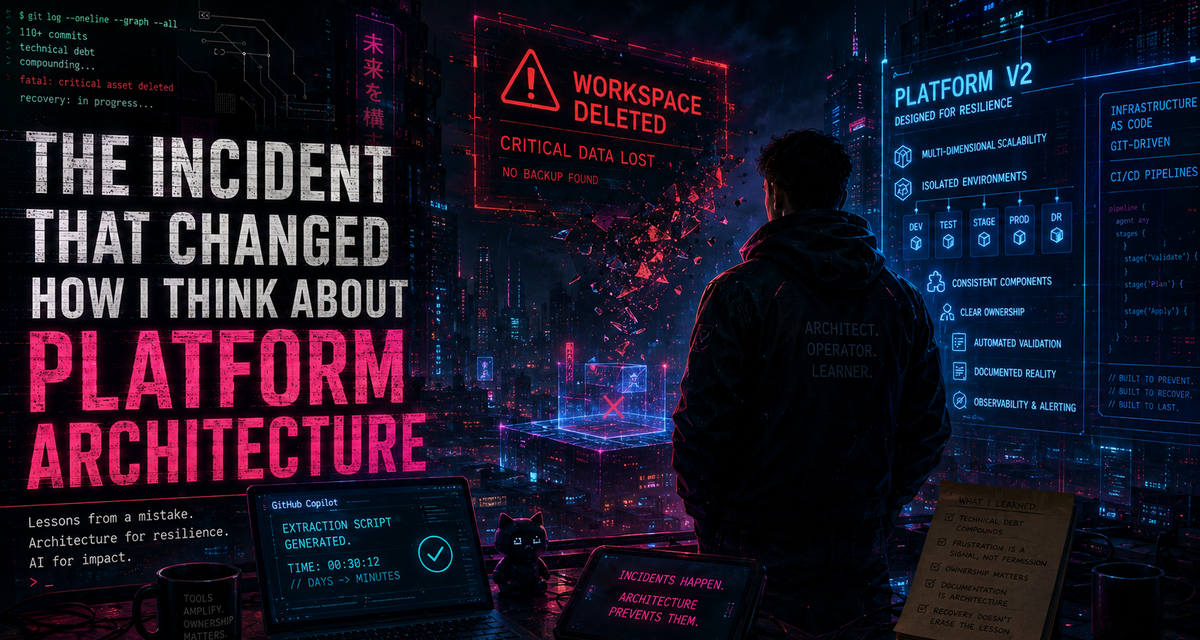
I once deleted a data team's critical workspace by accident. Their code, their artifacts, their months of work. Gone. They hadn't backed up anything.
It was one of the most stressful moments of my career. But it was also one of the most formative. That incident taught me more about platform architecture, technical debt, and human behavior than any design document ever could.
The platform nobody wanted to maintain
The platform was hosted on Azure and managed entirely through Infrastructure as Code. Everything was git-driven: the environments, the deployments, even the automated role assignments using service principals, managed identities, and custom runners. The complete management ran through automated pipelines in interconnected repositories.
On paper, it was a modern setup. In practice, it was poorly architected from the start. Five different environments, inconsistent infrastructure components across each one, some teams maintaining certain pieces while others ignored them entirely. Updating it was a nightmare. Cleaning it wasn't even on the table because nobody knew where to begin.
Some environments had certain components. Others didn't. Some teams worked on specific services while other teams ignored them. The platform had grown organically, with no coherent vision, no ownership model, and no documentation that reflected reality. Every change required understanding not just the component you were modifying, but how it interacted with a dozen other components across five environments.
I was managing this platform, and every day felt like playing whack-a-mole with infrastructure issues.
The frustration that led to the incident
One day, I was trying to patch a specific component in one environment. The platform was so inconsistent that what worked in one environment didn't work in another. I'd been debugging for hours, bouncing between environments, trying to understand why a simple update kept failing.
The frustration built. I wanted to fix the immediate problem, and I wanted to fix it now. We had a pending request to onboard another team into the platform, and it was a major update to the platform that would touch upon everything in it. In my attempt to surgically patch the mess, I made a decision I shouldn't have made. I deleted a workspace that I thought was a duplicate or test environment. It wasn't. It was the data team's critical workspace. Their code, their artifacts, their work. They hadn't backed up anything.
The moment I realized what I'd done, the blood drained from my face.
The aftermath
The workspace was eventually recovered, but the mark remained. Not just an incident report that would live in the system forever, but the realization that 110+ commits of haphazard patches and workarounds had led to this moment. Each commit was a small shortcut, a "I'll fix this properly later" decision that accumulated into a system so fragile that one wrong click could destroy something critical.
The incident forced me to confront something: frustration with a bad system doesn't excuse bypassing it recklessly. The platform was a mess, but my job was to manage it responsibly, not to vent my frustration on it.
The data team was gracious about it. They got their workspace back. But I didn't get over it easily. That incident became a permanent reminder of what happens when technical debt meets human frustration.
The recovery: where AI made the difference
After the workspace was recovered, the data team needed their code and artifacts extracted and restructured. Normally, this would have taken me a couple of days: learn the platform's APIs, implement the extraction logic, test it, structure the extracted content, and then deliver it to the team.
I gave GitHub Copilot the reference to the platform's API documentation and described what I needed. It generated the extraction script in minutes. I reviewed it, made a few adjustments, and ran it. The entire process took about thirty minutes. What would have been days of work became a single sitting.
That moment crystallized something for me about AI's role in engineering. It's not about replacing developers. It's about amplifying them. GitHub Copilot didn't write the architecture or make the decisions. It helped me execute faster so I could focus on the harder problems: making sure the extracted data was correct, structuring it properly, and communicating with the team about next steps.
It was one of the first times I used AI as a genuine productivity multiplier in a real production scenario, and it shaped how I think about AI adoption in engineering teams today. This is one of the reasons I'm working toward enabling and maturing others to adopt AI: I've seen firsthand how the right AI tools, used thoughtfully, can transform how teams respond to incidents and handle complex tasks.
Enter V2
After the incident, I couldn't go back to the way things were. The platform needed more than patches. It needed a redesign.
I started designing V2 of the platform with a completely different approach. Multi-dimensional scalability. Clean environment isolation. Consistent component deployment. Clear ownership models. Documentation that reflected reality, not aspiration. Automated validation to catch inconsistencies before they became problems.
The redesign took months. It wasn't glamorous work. But it was necessary. And it was some of the most satisfying architecture I've done, because I was solving a problem I'd lived with intimately.
Sometimes the best design work comes from living with the consequences of a bad one.
What I learned
- Technical debt is a compounding problem: Every shortcut, every "I'll fix it later," every undocumented decision adds up. Eventually, the system becomes so fragile that a single action can cause cascading failures. You can't predict when that moment will come, but you can be sure it will.
- Frustration is a signal, not a permission: When you're frustrated with a system, that frustration is telling you something important: the system needs to change. But frustration doesn't give you the right to bypass processes or make reckless decisions. It gives you the responsibility to fix the root cause.
- Ownership matters: The platform was a mess because nobody owned it holistically. Teams owned pieces, but nobody owned the whole. That lack of ownership allowed inconsistencies to grow unchecked. Platform architecture requires someone who sees the entire system and takes responsibility for its coherence.
- Documentation is architecture: The platform had documentation, but it didn't reflect reality. When your documentation and your system diverge, you don't have documentation. You have fiction. Real architecture includes accurate documentation as a first-class concern.
- Recovery doesn't erase the lesson: The workspace was recovered. The incident was resolved. But the lesson stayed with me. Some mistakes you make once and never repeat. That incident is one of mine.
The broader lesson
I see the same pattern everywhere I go. Organizations accumulate technical debt gradually, through a thousand small decisions that seem reasonable in isolation. Then one day, someone makes a decision that seems reckless, and the whole thing comes apart.
The solution isn't to blame the person who made the reckless decision. The solution is to ask why the system was so fragile that a single action could cause that much damage. Usually, the answer is: years of accumulated shortcuts, inconsistent architecture, and unclear ownership.
Platform architecture isn't about building the perfect system. It's about building a system that's resilient enough to survive human behavior. Because humans will always find the edge cases, the shortcuts, and the failure modes that your design didn't anticipate.
If you're dealing with platform architecture challenges, technical debt, or the aftermath of an incident, I'd be happy to connect. Reach out at zulmehdi.com or find me on LinkedIn.
If this post saved you time or gave you a new idea, consider buying me a coffee. No pressure. I write these because I enjoy sharing what I've learned.